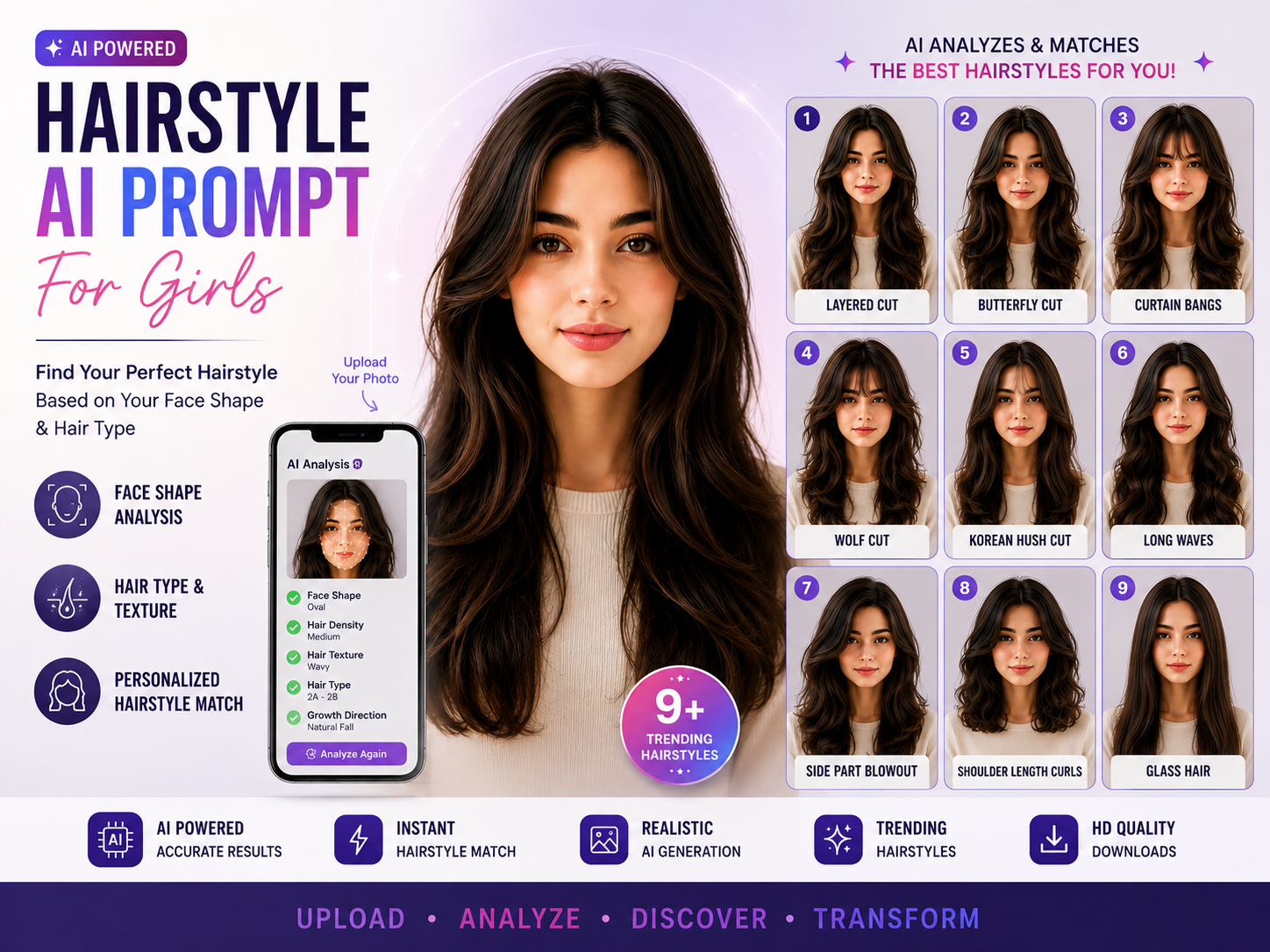
The AI Hairstyle Prompt for Girls: A Real Face Shape & Hair Type Breakdown

The AI Hairstyle Prompt for Girls: A Real Face Shape & Hair Type Breakdown
Why "just describe a haircut you like" almost never works on AI tools — and the exact copy-paste prompt that fixes it by analyzing your actual face shape and hair type first.
Jump to a section
Most "AI hairstyle generator" searches end the same way: you type something like "cute haircut for round face," the AI gives you a generic answer copied from a thousand other beauty blogs, and you're left guessing whether any of it actually applies to your face. The problem isn't the AI. It's the prompt. A prompt that doesn't analyze your photo can't give you a personalized answer — it can only give you an average.
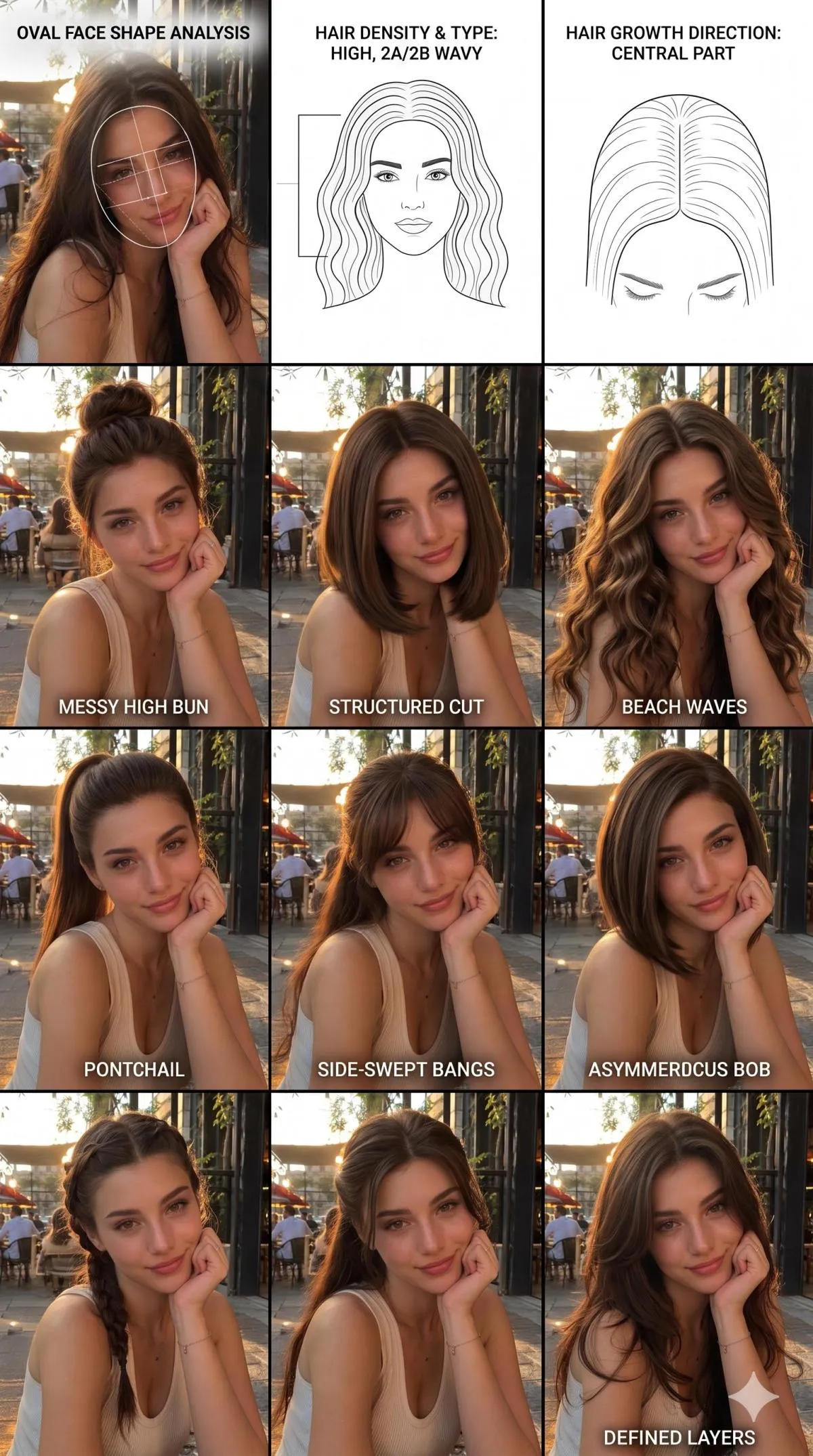
That's the gap this specific AI hairstyle prompt for girls is built to close. Instead of asking the AI to recommend a haircut from a text description, it asks the AI to look at your uploaded photo, identify your face shape and hair characteristics with precision, and generate a 4K reference grid built around what it actually sees. Below, we'll break down exactly how that analysis works, hand you the copy-paste prompt, and give you the face shape and hair type knowledge to interpret your results like a stylist would.
Why Face Shape Is the Missing Variable in Most Hairstyle Searches
Hair stylists don't pick a cut based on trends alone — they measure. Specifically, they're comparing four reference points: the width of your forehead, the width of your cheekbones, the width of your jaw, and the overall length of your face. The relationship between those four numbers is what determines whether a blunt bob will flatter you or fight you.
An AI face shape analysis is doing the same math, just from pixels instead of a tape measure. It estimates those four proportions from your photo, classifies the result into one of six standard shapes, and uses that classification to filter which silhouettes will actually balance your features. Skip this step, and you're choosing a hairstyle the same way you'd choose a font: by what looks nice in isolation, not by what looks nice on you.
The cut isn't the variable that changes. Your proportions are. The right prompt accounts for that before it generates anything.
How the AI Actually Analyzes You (Under the Hood)
When you read the prompt below, you'll notice it doesn't just say "suggest a hairstyle." It gives the AI a specific analysis checklist to run before it generates anything. That checklist is doing two jobs at once:
1. Face shape detection
The AI is instructed to identify your exact face shape — oval, round, square, heart, diamond, or long — by reading the relationship between your forehead, cheekbone, and jaw width, plus your overall face length. This is the same logic behind every haircut recommendation AI tool that's worth using: shape first, style second.
2. Hair type and growth analysis
The second half of the checklist covers your hair itself: density (how much hair you have), texture and curl pattern (straight through coily), and growth direction (which way your hair naturally falls or swirls, including your hairline). This is the part most generic "AI hairstyle ideas" prompts skip entirely — and it's the difference between a recommendation that looks good in a render and one that actually works once you're styling it at home.
Why this matters: A hairstyle that's correct for your face shape but wrong for your hair density or curl pattern still won't work. A wispy fringe drawn for fine, straight hair will behave completely differently on dense, coily hair. The combined analysis is what makes the output usable instead of decorative.
The Exact Prompt (Copy & Paste)
This is the live prompt from the AI Hairstyle Prompt for Girls page. Copy it as-is for a balanced, full-coverage analysis, or jump to the Korean hairstyle section below to see how to customize it toward a specific aesthetic.
Copy-Paste AI Hairstyle Prompt
Analyze the single image I upload.

Identify my exact face shape and hair type with precision.

Then generate a vertical 9:16 4K 3x3 grid of hairstyle reference images directly on my face.

Requirements:
Analyze the uploaded image to detect:
1. Face shape
2. Hair density, texture, curl pattern, and growth direction

Use this analysis to generate a 3x3 grid of photorealistic hairstyles tailored to my specific face shape and hair type, shown directly on my face, in consistent lighting and angle.
- 01Upload your photoUse a clear, front-facing photo in natural light with your hair pulled back enough to show your hairline and jaw.
- 02
- 03Generate & reviewYou'll get a 3×3 grid of hairstyles rendered on your actual face — use it as a moodboard, not a final decision.
Face Shape Cheat Sheet
Once you have your AI-generated grid, use this table to sanity-check the output and understand why certain cuts were suggested.
| Face shape | What defines it | Best directions | Generally avoid |
|---|---|---|---|
| Oval | Forehead slightly wider than jaw, gently curved jawline, balanced length | Almost everything works — curtain bangs, lobs, soft layers | Very blunt, one-length cuts that flatten the natural curve |
| Round | Width and length close to equal, full cheeks, soft jaw | Long layers past the chin, side-swept fringe, height at the crown | Chin-length blunt bobs, full round fringes |
| Square | Strong angular jaw, jaw width close to forehead width | Soft layered lobs, side-parted waves, wispy fringes | Blunt one-length bobs landing exactly at the jaw |
| Heart | Wider forehead, narrower chin | Chin-grazing lobs, side-swept bangs, jaw-level fullness | High-volume pixie cuts, severe middle-part blunt fringes |
| Diamond | Narrow forehead and jaw, wide cheekbones | Curtain bangs for forehead width, chin-length bobs to widen the jaw | Slicked-back styles with no width at the temples |
| Long | Face length notably greater than width | Fringes to shorten visual length, side volume, horizontal layers | Long, one-length hair with zero fringe or layering |
Hair Type Cheat Sheet
Face shape tells the AI what silhouette to suggest. Hair type tells it whether that silhouette will actually hold.
| Hair type | Pattern | What tends to work |
|---|---|---|
| Straight | Fine to coarse, no natural bend | Blunt bobs and lobs hold their shape cleanly; texturizing avoids flatness |
| Wavy | Loose S-pattern waves | Long layers enhance the natural wave; curtain bangs blend in easily |
| Curly | Springy curls or ringlets | Curl-by-curl shaping, layered curly bobs, shags that follow the curl |
| Coily | Tight coils, zigzag pattern | Cuts shaped with shrinkage in mind; layered styles and protective options |
Getting Korean Hairstyle Results From the Same Prompt
One of the most searched variations of this tool is for Korean hairstyle prompts specifically — soft layers, face-framing bangs, and that glass-hair finish associated with K-beauty looks. The base prompt above is intentionally style-neutral so the AI isn't biased toward one aesthetic. To steer it toward Korean hairstyle references, add a single modifier line right before "Requirements":
Korean Hairstyle Modifier
Style direction: Korean hairstyle aesthetic — prioritize soft layered "hush cut" or curtain bangs, face-framing layers, and a glass-hair, low-volume finish in the generated grid.
This is a useful trick beyond Korean styles too: any time you want to bias the output, add one specific style-direction line rather than rewriting the whole prompt. It keeps the analysis logic intact while changing the aesthetic lens the AI applies to it.
ChatGPT vs Gemini: Which Should You Use for This Prompt?
The prompt page gives you a one-click option for both, and honestly, either is a reasonable default. Here's how to decide between a ChatGPT hairstyle prompt for girls workflow and a Gemini hairstyle prompts for girls workflow:
Gemini
Good if you want the photo upload, analysis, and image generation to happen in one continuous thread with minimal friction. A solid default if you don't already have a strong preference.
ChatGPT
Good if you're already living inside ChatGPT for other tasks and want to keep your hairstyle exploration in the same place, with the same conversation history.
There's no wrong answer here — the prompt itself is the part doing the heavy lifting, not the platform. Run it in both if you're undecided and compare grids side by side.
5 Mistakes That Ruin Your AI Hairstyle Results
- Uploading a heavily filtered or dim photo. Beauty filters smooth jawlines and soften hairlines — exactly the data points the AI needs. Use an unfiltered, well-lit photo.
- Hiding your hairline or jaw with hair or hands. If the AI can't see the proportion, it can't analyze the proportion. Pull hair back from your face in the photo.
- Ignoring the hair-type half of the analysis. It's tempting to only care about face shape, but a style that ignores your curl pattern or density rarely survives contact with a blow dryer.
- Not mentioning length or maintenance limits. If you only wash and style your hair twice a week, say so. Add it as a constraint and the suggestions get noticeably more realistic.
- Treating one grid as the final answer. Run it again with a style modifier (like the Korean hairstyle line above) if the first result feels too generic — refining the prompt is normal, not a failure.
Frequently Asked Questions
Is the AI hairstyle prompt for girls actually free to use?
Does the AI hairstyle analysis work for every face shape and hair type?
Should I use Gemini or ChatGPT for this hairstyle prompt?
Do I need a professional photo for accurate face shape analysis?
Can I use this prompt to get Korean hairstyle ideas specifically?
Does the AI consider hair type or only face shape?
Can I bring the AI hairstyle results to my real hairstylist?
Try the AI Hairstyle Prompt Right Now
Copy the prompt, upload your photo, and get your personalized face shape and hair type grid in under a minute.
Get the Prompt →Related Prompts From the Library
This hairstyle prompt lives inside a much larger prompt library of copy-paste AI image prompts. A few worth exploring next:
Article and FAQPage JSON-LD are embedded in the <head> above and match the visible FAQ content exactly (required for rich result eligibility). Recommended additions when you publish: a BreadcrumbList schema matching the breadcrumb nav, and a HowTo schema for the 3-step "Upload → Paste → Generate" block if you want step-by-step rich results in Search.
Explore More AI Prompts
Looking for ready-to-copy ideas after reading this guide? Explore a rotating selection of AI image prompts from NanoAIPrompts.
AI Hairstyle Prompt For Girls | Face Shape & Hair Type Analysis
Copy prompt →
 Ultra-Realistic Indian Woman Saree Portrait Prompt
Copy prompt →
Ultra-Realistic Indian Woman Saree Portrait Prompt
Copy prompt →
 Couple Photo Prompt for AI Face Swap
Copy prompt →
Couple Photo Prompt for AI Face Swap
Copy prompt →
![Analog Film Look AI Prompt — Kodak Portra Style [Copy Paste]](https://nanoaiprompts.com/assets/uploads/img_6a79d19f2131b_1786368415.webp) Analog Film Look AI Prompt — Kodak Portra Style [Copy Paste]
Copy prompt →
Analog Film Look AI Prompt — Kodak Portra Style [Copy Paste]
Copy prompt →
 Watercolor and Ink Portrait Photo Editing Prompt
Copy prompt →
Watercolor and Ink Portrait Photo Editing Prompt
Copy prompt →
About the Author
The Nano AI Prompts team creates practical, high-fidelity prompt resources for modern AI image and photo editing tools.
Explore all AI prompts →